

Examinations are crucial for measuring learning progress, upholding academic standards, and serving as benchmarks for informed decision-making and selection in a competitive environment.
In Nigeria, JAMB UTME is a standardised exam for admission into universities, polytechnics, and colleges of education. It ensures a fair selection process for higher education. In addition to UTME, candidates must pass a post-UTME screening at their chosen institutions.
Before 2013, the JAMB UTME utilised Paper-Based Testing (PBT), which faced several issues, including logistical challenges, malpractice, and slow result processing. As the number of candidates increased, JAMB adopted Computer-Based Testing (CBT) to improve efficiency, security, and streamline the examination process, thereby modernising Nigeria’s standardised testing system and improving its integrity.
Since the introduction of CBT in 2013, trends in JAMB UTME results have shown consistent patterns in student performance. According to JAMB Registrar Prof. Ishaq Oloyede, the results from the 2025 exam align with performance statistics from the past 12 years. The percentage of candidates scoring above 300 has remained below 1%. In 2025, approximately 75% of candidates scored below 200, a trend consistent with that observed in previous years.
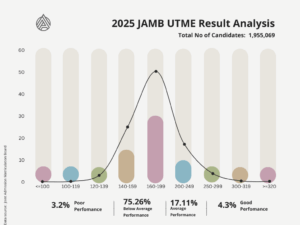
JAMB performance is often viewed as a reflection of the poor state of our educational system. While the concern about the educational system is valid, achieving consistent performance outcomes over a decade may indicate a different influencing variable. While CBT has reduced the malpractices and logistical issues faced by PBT, it may be an unintended factor responsible for lower performance over the last decade.
Therefore, important questions to ask are how many students have access to computers and testing experiences before the actual exam and how much computer use is available, especially in public schools. It’s unrealistic to expect good performance from students who may use a computer for the first time during the exam.
To improve CBT examination performance, the government needs to invest more in public school infrastructure. Students should have access to computer labs for learning and practice. Additionally, school curriculum should incorporate computer use in continuous assessments and homework from an early stage. State and Local Governments should establish digital centres in strategic locations for schools and students.
Also, focus should be on how students prepare for exams. Learning and reading are one thing, but preparing for a CBT examination is another.
We need a concerted effort to integrate technology into students’ learning experiences, provide proper teacher training and access to necessary resources and infrastructure. Only then can we expect real improvements in exam results.

