
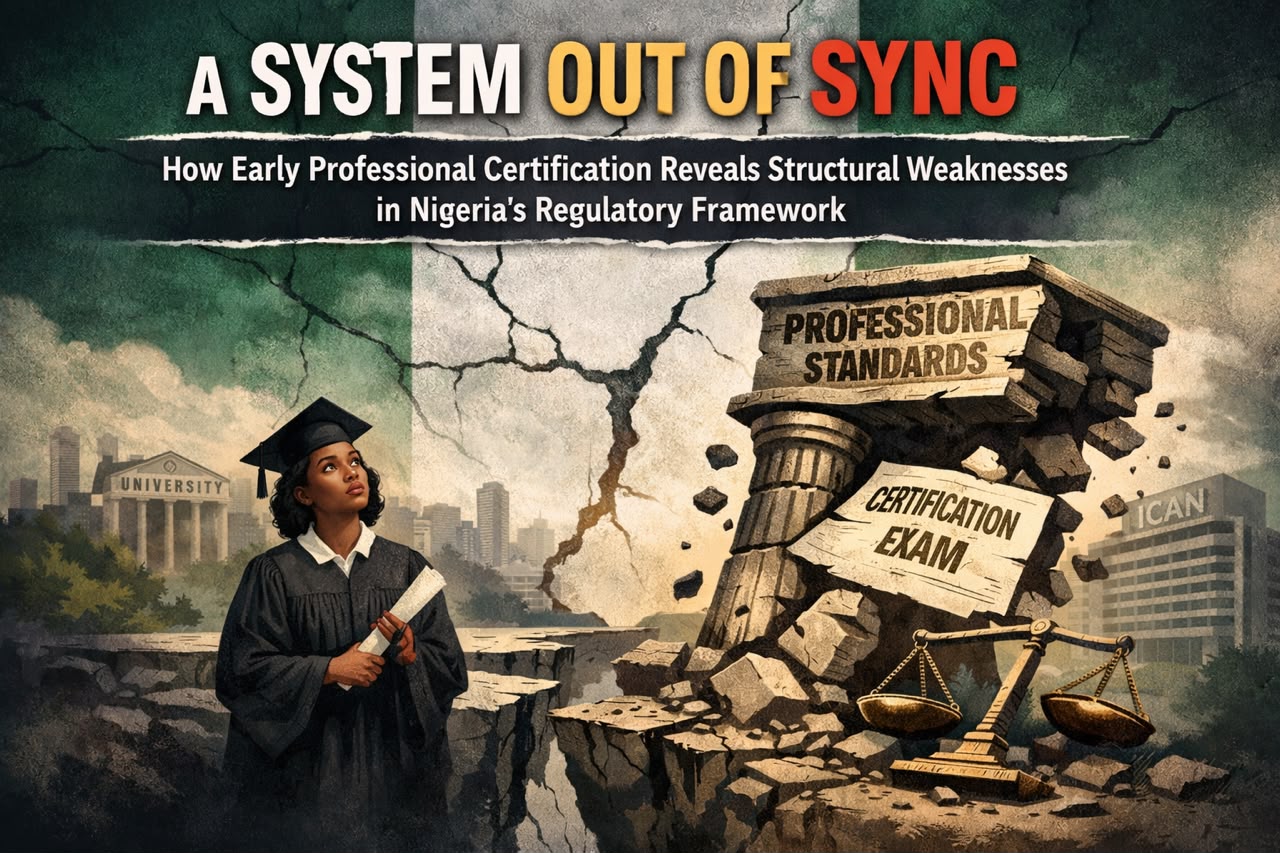
How Early Professional Certification Reveals Structural Weaknesses in Nigeria’s Regulatory Framework
The recent celebration of a 16‑year‑old becoming Nigeria’s youngest Chartered Accountant under the Institute of Chartered Accountants of Nigeria (ICAN) has captured public attention. Her achievement is remarkable and speaks to exceptional discipline and intellectual ability. Yet it also exposes a deeper policy concern about the coherence, credibility, and long‑term integrity of Nigeria’s professional qualification standards.
Professional certification is designed not only to test knowledge but to ensure readiness for real‑world responsibility. Globally, this readiness is understood to require structured learning, supervised practice, and a level of maturity that cannot be accelerated by brilliance alone. This is where Nigeria’s current framework shows significant gaps.
Comparable international bodies including the CPA in the United States, CPA Canada, and the ACCA in the United Kingdom, maintain strict eligibility criteria. These include minimum age thresholds, tertiary‑education requirements, and mandatory supervised professional experience. Under these systems, a 16‑year‑old can’t attain full chartered status. The rationale is clear that competence must be complemented by professional judgment, ethical exposure, and workplace experience.
Nigeria’s own National Policy on Education reinforces this principle by setting 16 as the minimum age for university entry. This acknowledges that intellectual development must be accompanied by emotional and social maturity. When a 16‑year‑old attains full chartered status without tertiary education or structured professional exposure, it raises questions about alignment between national education policy and professional certification standards.
Celebrating exceptional achievement is important, but it must not compromise the credibility of professional qualifications. International accounting bodies enforce minimum ages and supervised practice not to limit opportunity, but to protect the public and safeguard the profession’s reputation. Nigeria’s current framework, by allowing full chartered status at an age typically associated with secondary‑school completion, risks sending mixed signals about the rigour of its standards.
Introducing structured safeguards would not diminish the accomplishments of gifted young Nigerians. Instead, it would ensure that their achievements are recognised within a system that commands respect locally and internationally. Minimum age requirements, mandatory tertiary‑level learning, and supervised practical experience would align Nigeria with global norms while still allowing exceptional youths to progress through tiered pathways or provisional membership structures.
Strengthening these guardrails is essential to building a professional ecosystem in which every chartered qualification reflects competence, maturity, and global trust. The objective is not to restrict opportunity, but to reinforce a coherent, credible, and internationally respected professional‑standards framework.


Fola
July 12, 2026Well said but I think it depends on what the certification is intended to certify.
If a certification is meant to measure knowledge and technical competence, then intelligence is the primary criterion. For example, if someone whether they’re 16 or 60 can demonstrate they understand networking, programming, accounting, or another technical field by passing a rigorous exam, then they’ve shown that knowledge.
However, if the certification is interpreted as proof that someone is ready to practice independently as a professional, then knowledge alone isn’t enough. Professional competence also involves maturity, work experience, communication& teamwork, and professional responsibility
Banke Bello
July 13, 2026Thank you for speaking up for standards, my brother.Nigeria needs this clear thinking, because speed without depth is what we celebrate today. The youths get certified as professionals with no practical experience of the exact profession.
But if that’s the system, what do we do? no one wants his/her child to be left behind ✊
It’s not the best though
Moyo L
July 13, 2026I super agree Adeolu. Definitely, there is more to professional capability than passing certificate exams. I think it’s high time certification bodies self regulate. Does she qualify for a chartered accountant role? Can she now be employed as a chartered accountant… I doubt this!
Thanks for sharing.
Folake
July 14, 2026Well said but I think it depends on depends on what the certification is intended to certify.
If a certification is meant to measure knowledge and technical competence, then intelligence is the primary criterion. For example, if someone whether they’re 16 or 60 can demonstrate they understand networking, programming, accounting, or another technical field by passing a rigorous exam, then they’ve shown that knowledge.
However, if the certification is interpreted as proof that someone is ready to practice independently as a professional, then knowledge alone isn’t enough. Professional competence also involves maturity, work experience, communication& teamwork, and professional responsibility
Tola
July 14, 2026Exactly my thought when I saw the news
Our “anyhowness” is too much in this country
Tony
July 14, 2026Thought 💭 provoking and beautifully written. Cheers 🥂
Bose
July 14, 2026I totally agree with this
Abimbola
July 14, 2026I agree. Brilliance should be celebrated but a structure is needed too. Just writing tests is not a true measure of competency and emotional maturity
Titilayo
July 14, 2026You have said it all,how can a 16 year old be a chattered accountant, especially in a country that is complicated like Nigeria .She is not emotionally matured for such attainment, brilliance alone like you said is not enough for such a lofty goal ‘There should be age limit for any aspiring candidates.
Enitan
July 14, 2026I agree.
Why that is an exceptional feat, I preach maturity (emotional and psychological. It is very essential that maturity accompanies brilliance.